
EU Funding Just Shifted Gears. Here’s the 2026–2027 Playbook (without the fluff)
Last updated: December 2025
If you’ve been writing EU proposals the same way you did in 2023–2024, you’re probably leaving points (and sanity) on the table.
Because the Commission has just rolled out a noticeably different vibe for the final stretch of Horizon Europe: simpler, shorter, more “big bets,” and—crucially—more formats that change how you should plan, write, and even build your consortium.
Let’s break down what actually changed—and what you should do next.
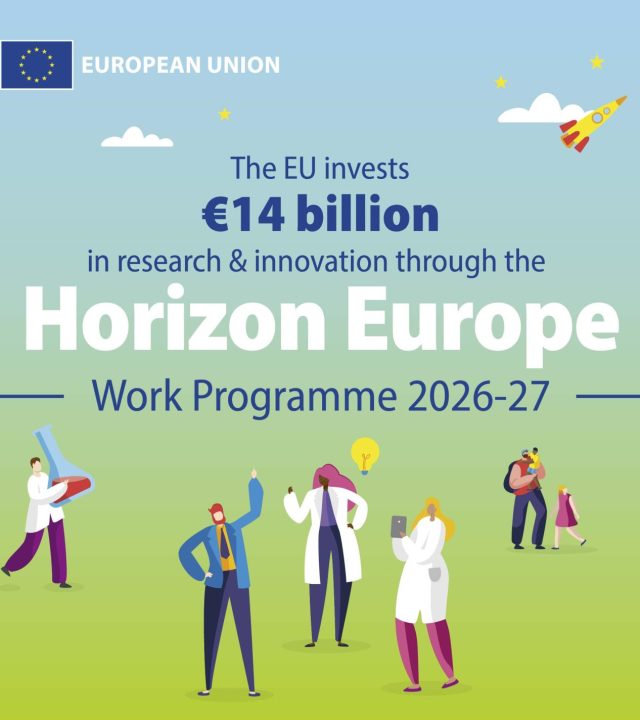
The headline: Horizon Europe 2026–2027 is officially adopted
The European Commission adopted the main Horizon Europe Work Programme 2026–2027 on 11 December 2025, with €14 billion planned investment. (European Union)
And it’s not just new topics. It’s a structural shift:
- the programme is less prescriptive and about one-third shorter than the previous edition (European Commission)
- it pushes fewer, larger projects (bigger consortia and bigger ambitions—done well, this is great; done badly, it’s chaos) (European Commission)
What changed (and why it matters)
1) Lump sums aren’t “a finance detail” anymore—they’re a design constraint.
The Commission states that half of the call budget is planned to be implemented through lump-sum funding. (European Commission)
Translation: you can’t hide weak planning behind accounting gymnastics. The winning move is deliverable-driven architecture:
- crisp outputs
- clean WP logic
- milestones that feel inevitable
Put simply: Lump sums reward teams that ship, not teams that explain costs beautifully.
The headline: Horizon Europe 2026–2027 is officially adopted
2) Two-stage calls are back in force (and they change your writing strategy)
The Work Programme includes 41 topics using two-stage evaluation. (European Commission)
Stage 1 is not “a shorter full proposal.” It’s a different genre:
- clarity beats detail
- fit beats completeness
- credibility beats complexity
Some short proposals may also be evaluated blind (anonymised). (European Commission)
Do this: write Stage 1 like a sharp editorial pitch—problem, idea, why you, why now—then keep a “Stage 2 expansion pack” ready.
3) Climate (still) sets the tone—and horizontal calls are getting louder
A Commission climate note states the WP dedicates at least 35% of its funding to climate goals. (Climate Action)
It also flags a new horizontal €540 million call linked to the Clean Industrial Deal, aimed at “fit-for-deployment” projects with industrial competitiveness. (Climate Action)
Translation: if you can credibly connect your innovation to deployment pathways and competitiveness, your impact story gets easier to sell.
Digital Europe also moved: the October 2025 amendment you don’t want to miss
If you work anywhere near AI, data spaces, digital public services, cybersecurity, EDIHs, or deployment-heavy pilots: Digital Europe’s Work Programme 2025–2027 got an official amendment (6 Oct 2025) via a Commission Implementing Decision. (Digital Europe Programme)
The Commission explicitly notes the amendment contributes to initiatives like AI Gigafactories. (Digital Europe Programme)
The “Don’t get disqualified quietly” section (aka: templates & guidance that keep changing)
Bookmark-worthy (official) guidance you should actually use
- Online Manual (Funding & Tenders Portal procedures & IT workflow): your submission mechanics bible. (European Commission)
- EU Grants AGA (Annotated Grant Agreement): how rules are interpreted in real life. (European Commission)
- Unit costs & contributions (Annex 2a/2b): updated versions matter—this one shows V1.10 – 15.12.2025. (European Commission)
- Data Management Plan (DMP): the Model Grant Agreement requires it to be established and regularly updated, and there’s an official template. (European Commission)
And yes—page limits still exist (and still hurt). The General Annexes spell them out for many cases. (Research and innovation)
Your 10-minute upgrade: what to do next week
If you coordinate proposals
- Call triage: label every target topic as lump sum / non-lump sum, one-stage / two-stage, and whether any blind evaluation applies. (European Commission)
- Build a deliverable-first skeleton before writing prose (especially lump sum). (European Commission)
- Draft a Stage-1 narrative that reads like a confident pitch, not a compressed report. (European Commission)
If you join consortia
- Ask one blunt question early: “What are we shipping by month 18?”
- Offer something concrete: a pilot site, dataset, committed stakeholders, deployment partner, standardisation pathway.
- If it’s two-stage: volunteer to help craft the Stage 1—it’s where many teams either win fast or die early. (European Commission)
The next horizon: €175bn is on the table (but politics will decide)
In July 2025, the Commission proposed a future Horizon Europe 2028–2034 with a €175 billion budget framing—part of the next long-term EU budget proposal. (Research and innovation)
That’s the direction of travel: bigger, simpler, faster (at least in messaging). (Research and innovation)
But the budget debate is politically charged and still unfolding. (Reuters)